Tyr Armor Guide: Heavy Tank vs Light Tank Armor Thickness Explained
Okay, I need to talk about this because it’s living rent-free in my brain. I’ve put way too many hours into Tyr since it dropped this September, and I finally understand why my clan chat has turned into a 3-hour armor-angling debate every single night. This isn’t your average ‘point gun, hold trigger’ tank shooter. Stoke Games actually built a game where thinking beats twitching, and the entire system hinges on one gorgeous, brutal mechanic: armor thickness.
I’ve died in humiliating ways because I didn’t understand this. I’ve also carried entire matches once I did understand it. So let me save you the pain and break down exactly how heavy tank armor stacks up against light tank armor, why it matters more than your aim, and how to stop exploding every time someone looks at you funny.
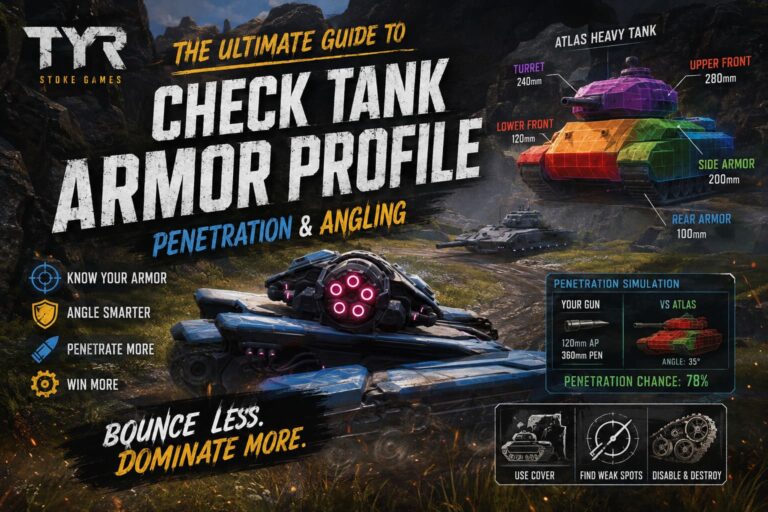
How to Check Tank Armor Profile in Tyr: The Ultimate Guide to Penetration and Angling (Stoke Games)
Why Armor Is the Real MVP of Tyr
Here’s the thing that took me embarrassingly long to grasp: in Tyr, your reflexes are secondary. Your class choice and positioning are primary. The moment I stopped playing this like a twitch shooter and started playing it like a chess match, my win rate genuinely turned around. And it all comes down to two wildly different philosophies:
- Heavy tanks say ‘hit me, I dare you.’
- Light tanks say ‘you’ll never even see me.’
Both are valid. Both are terrifying in the right hands. Let’s get into it.
Heavy Tanks: The Moving Fortresses That Make You Feel Invincible (Until You’re Not)
Rolling out in an Atlas for the first time is a genuinely emotional experience. There’s a certain smugness that comes with tanking three shots that would delete a lighter vehicle instantly. Heavies like the Atlas, Fortis, and Helio exist to eat damage, hold choke points, and make the enemy team question their life choices.
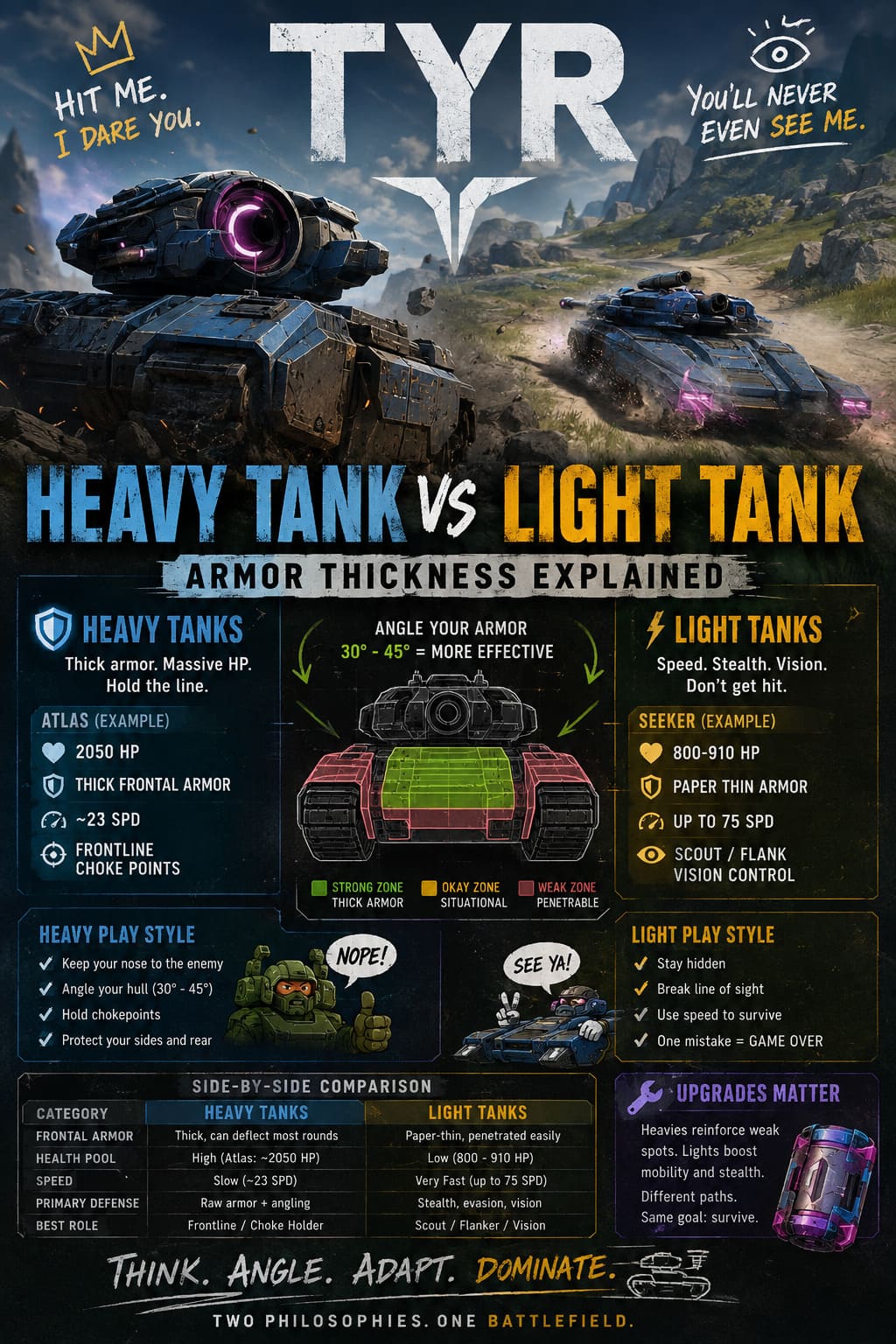
The numbers back up the swagger. The Atlas alone rolls with a jaw-dropping 2050 HP base health pool, paired with dense frontal plating built to laugh off low-penetration rounds. When I first started camping a capture point with mine, enemy shots were literally bouncing off my hull like pebbles off a windshield. It’s satisfying in a way few games manage to replicate.
But — and this is the part every new heavy player learns the hard way — that armor isn’t uniform. It’s concentrated almost entirely on:
- The upper glacis plate (front hull)
- The turret face
That’s it. That’s the fortress. Everything else? Paper. The second you expose your side or rear to an enemy, you might as well have painted a target on your engine block. I learned this lesson via a Kestrel that flanked me while I was busy feeling invincible, and let’s just say my HP bar disappeared faster than my dignity.
The Golden Rule of Heavy Play
If you remember nothing else from this rewrite, remember this: your nose is your shield. Keep it pointed at danger. Always.
Light Tanks: Glass Cannons That Live and Die by Stealth
Now let’s talk about the other half of my personality: light tanks. Vehicles like the Seeker, Kestrel, and Phantom throw armor thickness out the window entirely. We’re talking 800–910 HP, hull plating so thin it might as well be aluminum foil, and a playstyle that punishes even a single mistake with total annihilation.
Here’s the harsh truth nobody tells new players: a light tank isn’t supposed to survive a direct hit. It’s supposed to never take one in the first place. Your armor is theoretical. Your real defense is:
- Staying hidden using Tyr’s asymmetric spotting mechanics
- Breaking line of sight constantly
- Using absurd speed to simply not be where the shell lands
The first time I got caught in the open in a Seeker, one shot from a medium tank chewed through roughly half my health bar. One shot. That’s the deal you sign up for when you pick a scout.
Head-to-Head: How These Two Philosophies Actually Compare
I keep seeing forum threads argue past each other because people compare heavies and lights like they’re supposed to do the same job. They’re not. Here’s the breakdown I wish someone had shown me on day one:
| Category | Heavy Tanks (Atlas, Fortis, Helio) | Light Tanks (Seeker, Kestrel, Phantom) |
|---|---|---|
| Frontal Armor | Thick, reinforced, can deflect most standard rounds | Paper-thin, penetrable at almost any angle |
| Health Pool | Massive (Atlas: ~2050 HP) | Fragile (roughly 800–910 HP) |
| Speed | Slow, around 23 SPD | Blazing fast, up to 75 SPD |
| Primary Defense | Raw armor + angling | Stealth, evasion, spotting mechanics |
| Best Role | Frontline tank, choke-point holder | Scout, flanker, vision provider |
Honestly, once I stopped trying to force one class to do the other’s job, the game clicked into place.

Angling: The Mechanic That Separates Good Heavy Players From Great Ones
This is the part that genuinely blew my mind when I first understood it. Tyr doesn’t use flat armor values — it uses actual ballistic geometry. A shell hitting your hull straight-on sees your listed armor thickness. A shell hitting your hull at an angle sees something very different.
When a heavy tank angles its hull roughly 30 to 45 degrees relative to an incoming shot, the effective thickness the shell has to punch through increases dramatically. I’m talking shots that should absolutely wreck you instead ricocheting off harmlessly with a satisfying clang. It genuinely feels like cheating the first few times it works in your favor.
Here’s the kicker though: this trick barely helps light tanks. Their base armor is so thin that even a perfectly angled hull still gets penetrated by most anti-tank rounds. So if you’re driving a Seeker or Phantom, don’t bother trying to tank a shot at an angle and hope for the best — cover is your only real friend.
Quick Cheat Sheet: What Actually Keeps You Alive
- Heavy players: Never expose your side/rear armor unnecessarily. Angle aggressively. Hold chokepoints, don’t chase.
- Light players: Assume every hit will hurt badly. Use terrain and vision mechanics, not armor, to survive.
- Everyone: Learn where the weak zones are on enemy vehicles — lower glacis, turret rings, engine decks. Aim for those.
Upgrades: Building Your Playstyle Even Deeper
What genuinely impressed me is how far Stoke Games took the customization systems. This isn’t a cosmetic-only progression tree — it actually reshapes how your vehicle survives.
Heavy tank commanders can invest in reinforced plating components that specifically shield vulnerable systems like the engine or fuel tanks from getting critically damaged mid-fight. Meanwhile, light tank drivers can’t magically grow armor, but they can pump upgrades into mobility, stealth thresholds, and escape-oriented utility abilities that let them slip out of ambushes they’d otherwise never survive.
It’s a smart design choice, honestly. Rather than letting one class creep into the other’s territory, the upgrade trees just make each class more like itself.
So… Which One Should You Actually Play?
I’ve gone back and forth on this more times than I’d like to admit, but here’s my honest take after way too many matches:
- If you love being the center of attention, soaking up damage, and holding the line while your team pushes behind you — go heavy. You’ll feel like an unstoppable wall of steel, right up until someone flanks you (don’t let them).
- If you love outplaying opponents with your brain instead of your health bar, thrive on information and positioning, and get a dopamine hit every time you vanish before an enemy even knows you were there — go light. Just accept that one mistake can and will end your run instantly.
Either way, understanding the raw mechanics behind heavy and light armor thickness in Tyr isn’t optional trivia — it’s the actual skill ceiling of this game. Once it clicks, you stop dying to ‘unfair’ shots and start winning fights you have no business winning.
See you on the battlefield. I’ll be the one either shrugging off your shells or making sure you never see me coming.